


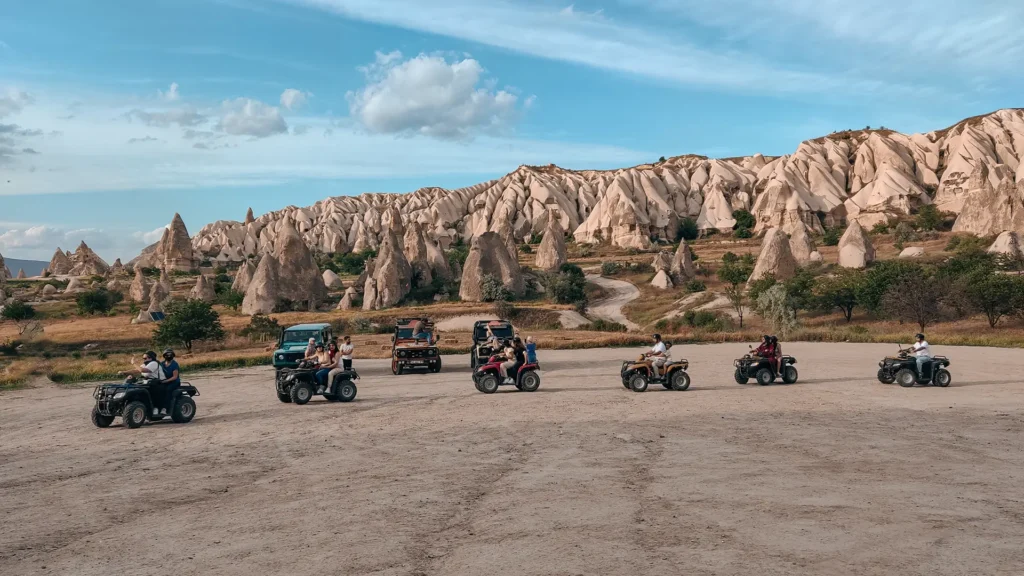
Most pages that describe the Cappadocia ATV tour list the valley names and move on. Love Valley — check. Rose Valley — check. Sword Valley — check. What they don’t explain is why those valleys are on the route, what you’ll actually see in each one, and how the character of each valley changes the experience depending on what time of day you’re riding.
I’ve been leading tours through these valleys for 15 years. Here’s what the route actually looks like.
The Standard Route: Four Valleys, Two Hours
The 2-hour Cappadocia ATV tour covers four locations: Love Valley, Mushroom Rock near Çavuşin, Sword Valley (Kılıçlar), and Rose Valley (Güllüdere). The 1-hour tour covers a shorter circuit within the same valley system. The order and specific sections can vary slightly by season and conditions, but these are the four locations the route is built around.
Each valley has a different geological formation, a different visual character, and a different reason for being on the route. They’re not interchangeable.
Love Valley — Fairy Chimneys and the Valley Floor
Love Valley is where most ATV tours begin. The valley is best known for its fairy chimneys — the tall tuff columns with rounded capstones known in Turkish as peri bacaları — that have become the defining image of Cappadocia.
The formation process takes millions of years. Around 10–11 million years ago, volcanic eruptions from Mount Erciyes and Mount Hasan blanketed the plateau with thick layers of ash, which compressed into soft volcanic tuff. A harder caprock layer sits on top. As rain and wind eroded the softer tuff around the harder tops, the columns were left standing — the caprock protected the material directly beneath it while everything else wore away.
What makes Love Valley distinct from other valley sections of the route is the concentration and height of these formations. The columns here reach 20–30 metres. The ATV track runs along the valley floor, which puts you at the base of these structures looking up — a perspective that photographs from a viewpoint above cannot replicate.
Mushroom Rock, Çavuşin — A Different Stage of the Same Process
Mushroom Rock sits near Çavuşin, roughly at the midpoint of the route. The formation shows what happens later in the erosion cycle: the capstone is larger, the column underneath narrower. It resembles a mushroom more than the cylindrical fairy chimneys of Love Valley — the base has eroded more significantly while the top remains protected.
Çavuşin itself is worth noting. The hillside above the modern village contains an abandoned settlement carved directly into the tuff cliff face. The residents of Old Çavuşin lived in these rock-cut houses until the 1950s, when structural instability — the same erosion process that formed the valley — made the dwellings unsafe. The ATV route passes the base of the cliff. You can see the hollowed-out windows and doorways of the old houses from the track.
Sword Valley (Kılıçlar) — The Most Technical Section
Sword Valley takes its name from the narrow, blade-like rock formations along its walls — kılıç means sword in Turkish. The valley is geologically more varied than Love Valley: the tuff layers here include different mineral compositions, which creates a wider range of colours and textures in the cliff faces.
This is the most technically demanding section of the ATV route. The track narrows in places, and the terrain is less predictable than the open valley floor of Love Valley. For most riders this is a positive — it’s where the ride feels most like actual off-road driving rather than a guided scenic circuit.
What most tour pages don’t mention: Byzantine monks carved rock churches into this valley between the 7th and 11th centuries. Several are still visible from the track — hollow cavities in the cliff face, some with traces of carved architectural detail around the entrance. The valley was a monastic zone for several centuries before being abandoned. If you look at the cliff walls as you ride through rather than at the track, you’ll see them.
Rose Valley (Güllüdere) — The Timing Matters Here
Rose Valley closes the 2-hour route. The valley name comes from the colour: the tuff here has a higher iron oxide content than the formations in Love Valley or Sword Valley. Iron oxide produces the pink and amber tones that the valley is known for.
The critical point about Rose Valley is that the colour is light-dependent. At midday, under flat overhead sun, the valley walls read as pale ochre — attractive, but not dramatically different from any other tuff formation. In the last hour before sunset, when the sun is low on the horizon, the light catches the iron-rich faces at an angle and the colour shifts into deep rose and copper. The valley earns its name only in that light.
This is why the sunset ATV tour exists and why it’s the most popular option. The route finishes in Rose Valley precisely because the timing lands the sunset where the colour payoff is highest.
At sunrise, the effect works in reverse — the early light catches the valley on the eastern-facing walls first, before the sun rises fully. It’s a different quality of light than sunset but equally specific to the geology.
What the 1-Hour Tour Covers
The 1-hour tour covers a shorter circuit within the same valley system — primarily the lower section of Rose Valley and the approach from the Göreme side. You won’t reach Mushroom Rock or the full length of Sword Valley. If the valley geology and the Byzantine rock churches are part of what you want to see, the 2-hour tour is the one that covers that ground.
Morning, Sunset, or Daytime — How Timing Changes Each Valley
The four valleys on this route each behave differently at different times of day:
Love Valley works at any time. The fairy chimney formations are visible in all light conditions and the valley floor track is wide enough that dust is less of an issue than in narrower sections.
Mushroom Rock and Çavuşin are best in the morning or late afternoon when the low-angle light picks out the texture of the tuff formations and the detail of the Old Çavuşin cliff houses. At midday, the texture flattens.
Sword Valley is best avoided in the peak midday heat — the narrow sections trap heat and dust. Morning is the most comfortable timing here; the light on the cliff faces is also better for seeing the rock church cavities.
Rose Valley is a sunset valley. Morning works if the balloon launch is a priority — you’ll ride through with hot air balloons ascending overhead. Daytime is fine but the colour payoff is reduced. Sunset is the reason the valley has the name it has.
The 2-hour sunset tour is the standard recommendation because it sequences the route to land in Rose Valley at golden hour. The 2-hour sunrise tour is the alternative if you want the balloon backdrop and cooler temperatures. Both cover the same four valleys.
Book the Cappadocia ATV Tour
The ATV tour described in this guide departs from Göreme with hotel pickup from Göreme, Çavuşin, Uçhisar, and Ürgüp. Duration options are 1 hour (€17) and 2 hours (€30), with sunrise and sunset timings available.
→ Book the Cappadocia ATV Tour (Quad Bike)
FAQ — Cappadocia ATV Tour Valleys
Which valleys does the Cappadocia ATV tour cover?
The standard 2-hour tour covers Love Valley, Mushroom Rock near Çavuşin, Sword Valley (Kılıçlar), and Rose Valley (Güllüdere). The 1-hour tour covers a shorter circuit within the same valley system, primarily Rose Valley and the Göreme approach.
Why is Rose Valley the best at sunset?
Rose Valley's tuff has a higher iron oxide content than other valleys on the route. Iron oxide produces pink and amber tones that are most visible in low-angle light — the last hour before sunset. At midday under flat overhead light, the colour is significantly less dramatic.
What is the geological formation process behind the Cappadocia fairy chimneys?
Volcanic eruptions 10–11 million years ago deposited thick layers of ash across the plateau, which compressed into soft volcanic tuff. A harder caprock layer on top protected the material directly beneath it as rain and wind eroded the softer surrounding tuff. The columns left standing — with harder tops and eroded bases — are what became known as fairy chimneys.
Are there historical sites along the Cappadocia ATV route?
Yes. Mushroom Rock passes the base of Old Çavuşin, an abandoned Byzantine-era settlement carved into the tuff cliff face, inhabited until the 1950s. Sword Valley contains rock-cut cave churches carved between the 7th and 11th centuries, visible from the track as hollow cavities in the cliff walls.
Is the ATV tour dusty?
Yes, particularly in the drier summer months (July–August). The tuff soil in the valleys is fine and becomes airborne easily. Helmet, goggles, knee pads, and elbow pads are provided free of charge. Bandanas are available to purchase on-site. Dust masks are no longer provided — operators stopped supplying them due to hygiene concerns with shared use. If you have asthma, allergies, or wear contact lenses, bring your own mask. The shared goggles are cleaned between tours, but if hygiene is a concern, bringing your own is the cleaner option.
Does the 1-hour tour cover all four valleys?
No. The 1-hour tour covers a shorter circuit and does not reach Mushroom Rock or the full Sword Valley section. The 2-hour tour covers all four locations listed in this guide.
Yusuf Demir
Professional Tour Guide | Archaeology | History | Art
He has led more than 3,800 tours across Turkey — from the underground cities of Cappadocia to the marble streets of Ephesus. He also spent a year working ground crew and operations at a Cappadocia balloon company — he knows firsthand how SHGM makes pre-dawn flight decisions and what pilots look for before launch. His academic background in Archaeology, Art History, and History of Religions shapes every itinerary he designs. This guide reflects what he actually tells people on the ground, not what looks good on a brochure.