


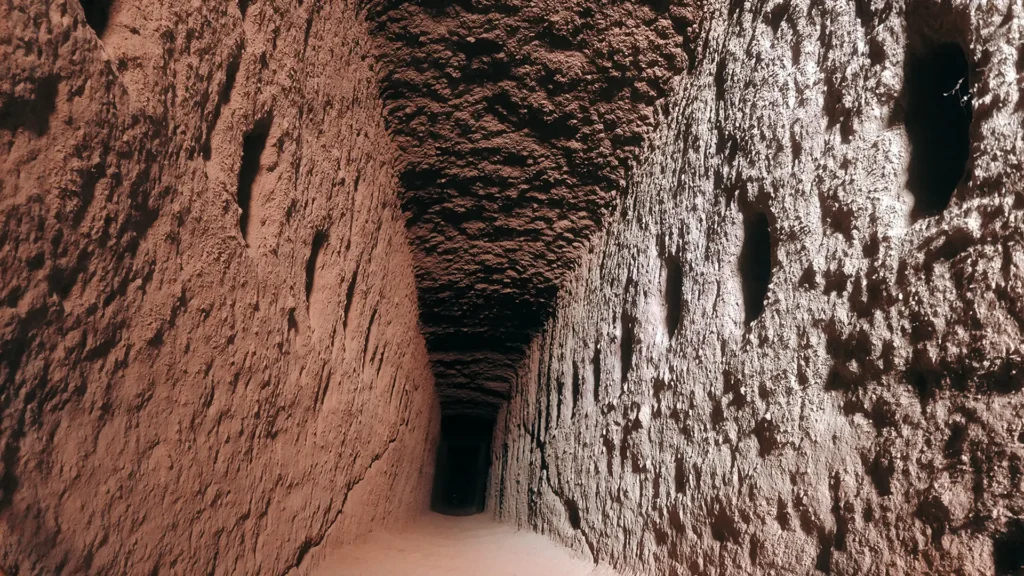
Cappadocia is home to more than 25 underground cities carved into volcanic rock, and the two most extraordinary — Kaymaklı and Derinkuyu — are what make a Cappadocia underground cities tour unlike anything else in Turkey. Kaymaklı Underground City (open daily, entrance fee ~€13, 4 open levels of 6 total) sits beneath the town of Kaymaklı and once sheltered an estimated 3,500 people in interconnected tunnels, stables, kitchens, and ventilation shafts. Derinkuyu, 10 km south, descends 11 levels to 85 metres deep and is the deepest underground city in the world open to visitors. Both sites are included on the Cappadocia Green Tour — and after guiding thousands of visitors through these tunnels over 15 years, I can say with certainty: nothing prepares you for the scale of what ancient civilizations — from the Hittites to the Phrygians, and later the early Christian communities who expanded and sheltered within them — carved and shaped beneath this landscape over thousands of years.
Why Did People Build Cappadocia Underground Cities?
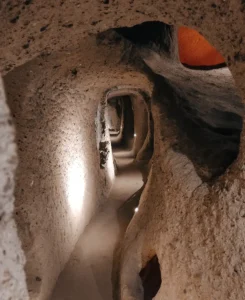
Cappadocia’s underground cities were not built in a single period or by a single civilization — they evolved over thousands of years as the region changed hands between empires. The volcanic tuff rock that defines Cappadocia’s landscape is uniquely soft when first exposed to air, hardening over time into a durable material that can be carved with basic tools. This geological accident made underground construction not just possible but practical.
The earliest evidence of underground habitation in Cappadocia dates to the Hittite period, around 1650 BCE, when subterranean storage rooms and shelters were first carved into the rock. Later, Phrygian communities expanded these spaces. The most significant period of development came between the 6th and 10th centuries CE, when early Christian communities —Byzantine persecution and later fleeing Arab raids — transformed existing caves into fully functional underground settlements capable of supporting thousands of people for extended periods.
Cappadocia’s underground cities served three primary functions: refuge during military invasions, storage for food and livestock during harsh winters, and permanent habitation for communities that could not safely live above ground. The ventilation systems, water wells, wine presses, and stone doors found in these cities confirm they were designed not as temporary shelters but as long-term living environments.
Kaymaklı Underground City: What to Expect
Kaymaklı Underground City sits directly beneath the modern town of Kaymaklı, 25 km south of Göreme, and is the most visited underground city in Cappadocia. The city extends 6 levels deep into the volcanic rock, though only 4 levels are currently open to visitors — the lower levels remain under archaeological study.
What you’ll see on the 4 open levels:
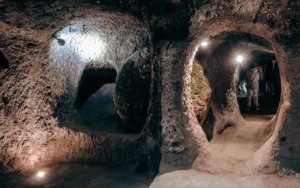
The first level contains stables with carved stone feeding troughs still intact — animals were brought underground during raids for protection and warmth.The second level contains a church with two apses — the first thing early Christian inhabitants built when establishing a new underground settlement. The third level reveals a large communal kitchen with blackened ceilings from centuries of cooking fires, alongside storage rooms filled with large ceramic vessels carved directly into the rock walls. The fourth level holds a wine press and more storage areas, with narrow connecting tunnels that required inhabitants to crouch and move single-file — a deliberate defensive design that prevented invaders from advancing quickly.
Stone doors — large circular millstone-like discs weighing up to 500 kg — were rolled across tunnel entrances from the inside, making Kaymaklı impenetrable from above ground. These doors could only be opened from within, meaning the city was designed exclusively for defense from external attack.
Practical visitor information:
- Location: Kaymaklı town center, 25 km from Göreme
- Opening hours: Daily 08:00–18:15 (summer), 08:00–16:15 (winter)
- Entrance fee: ~13.EUR (subject to change)
- Time needed: 30–45 minutes
- Physical requirement: Some low passages requiring crouching; not recommended for severe claustrophobia
Derinkuyu Underground City: The Deepest in the World
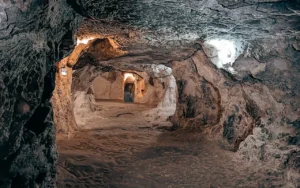
Derinkuyu, located 10 km south of Kaymaklı, is the deepest and most architecturally complex underground city in Cappadocia — and the deepest ancient underground settlement open to visitors anywhere in the world. The city descends 11 levels to a depth of 85 metres and is estimated to have housed up to 20,000 people at its peak capacity, with a sophisticated infrastructure that included schools, wineries, oil presses, a missionary school, and a cruciform-shaped church on the lowest accessible level.
The most remarkable engineering feat at Derinkuyu is its ventilation system: a central air shaft 55 metres deep supplies fresh air to all levels simultaneously, a feat of ancient engineering that kept the underground population alive for months at a time without returning to the surface. More than 600 entrances to Derinkuyu have been discovered hidden beneath homes in the surrounding village — meaning the entire town above ground was effectively the roof of the city below.
Derinkuyu vs Kaymaklı — key differences:
Derinkuyu is larger, deeper, and more architecturally complex than Kaymaklı, but also more physically demanding — the passages are narrower and the descent steeper. Kaymaklı is more accessible for families and visitors with mobility concerns. For those who can only visit one, Derinkuyu offers the more dramatic experience; Kaymaklı is the better choice for families with young children or older travelers.
How Were the Cappadocia Underground Cities Discovered?
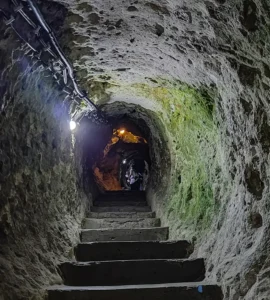
The modern rediscovery of Cappadocia’s underground cities is surprisingly recent. Derinkuyu was discovered in 1963 when a local resident broke through a wall in his basement and found the tunnel system behind it. Kaymaklı was formally opened to tourists in 1964. Archaeologists estimate that only a fraction of Cappadocia’s underground network has been fully mapped, rest of the cities still to be uncovered.
The most recent significant discovery was in 2014, when construction work in the Nevşehir city center uncovered an entirely new underground city beneath the modern urban area — potentially larger than Derinkuyu, with an estimated capacity of 60,000 people. Excavations are still in progress and some small sections can be visited, but its existence confirms that what tourists see today represents only a partial picture of what lies beneath the Cappadocia plateau.
Visiting Underground Cities on the Cappadocia Green Tour
Both Kaymaklı and Derinkuyu are included on the Cappadocia Green Tour route, which covers southern Cappadocia in a full-day 7–8 hour itinerary. The tour visits one underground city (Kaymaklı or Derinkuyu depending on seasonal crowd management), followed by the 3 km Ihlara Valley hike and Selime Monastery.
Having a professional guide inside the underground city makes a significant practical and historical difference — the tunnel system is disorienting without guidance, and the historical context of each level (why the kitchen is here, what the stone doors weigh, how the ventilation system works) transforms what would otherwise be a confusing crawl through dark passages into one of the most memorable 45 minutes in Turkey.
For travelers who want to visit both Kaymaklı and Derinkuyu in the same day alongside other southern Cappadocia sites, the Private Cappadocia Blue Tour can be customized to include both cities with dedicated time at each.
Quick Reference: Kaymaklı vs Derinkuyu
| Kaymaklı | Derinkuyu | |
|---|---|---|
| Depth | 6 levels (4 open) | 11 levels (8 open) |
| Max depth | ~40 metres | 85 metres |
| Estimated capacity | 3,500 people | 20,000 people |
| Distance from Göreme | 25 km | 35 km |
| Physical difficulty | Moderate | Moderate–High |
| Best for | Families, first-timers | History enthusiasts, adventurers |
| Included in Green Tour | ✅ Yes | ✅ Yes (alternates) |
| Time needed | 30–45 min | 45–60 min |
FAQ — Cappadocia Underground Cities
Is Kaymaklı or Derinkuyu better for first-time visitors?
Kaymaklı is the better starting point for most first-time visitors — it’s closer to Göreme, the passages are slightly more accessible, and 4 open levels provide a complete picture of underground city life without the physical demands of Derinkuyu’s deeper descent. If you have time for only one, choose Kaymaklı. If you want the most dramatic experience and have no mobility concerns, Derinkuyu is extraordinary.
What should I wear to visit the underground cities?
Comfortable, closed-toe shoes with grip — the floors are uneven stone and can be slippery. A light jacket is recommended even in summer, as temperatures inside maintain a constant 15°C regardless of outside conditions. Avoid high heels or sandals entirely.
Are the underground cities safe for children?
Yes, with some considerations. Both cities have low passages that require adults to crouch — children navigate these more easily. The lighting is adequate but atmospheric. Children who are comfortable in enclosed spaces typically find the underground cities one of the most exciting stops in Cappadocia. If your child experiences claustrophobia, it’s worth assessing at the entrance before descending.
How long does it take to visit an underground city?
Allow 30–45 minutes for Kaymaklı and 45–60 minutes for Derinkuyu. On the Green Tour, your guide will allocate sufficient time and lead you through all open levels with historical commentary — independent visitors often miss significant areas without guidance.
Can I visit the underground cities independently or do I need a guide?
Both cities can be visited independently with an entrance ticket. However, the tunnel systems are complex and poorly signed — most independent visitors report missing entire sections. A professional guide not only prevents you from getting lost but provides the historical and archaeological context that makes the visit genuinely meaningful rather than just physically interesting.
Yusuf Demir
Professional Tour Guide | Archaeology | History | Art
He has led more than 3,800 tours across Turkey — from the underground cities of Cappadocia to the marble streets of Ephesus. He also spent a year working ground crew and operations at a Cappadocia balloon company — he knows firsthand how SHGM makes pre-dawn flight decisions and what pilots look for before launch. His academic background in Archaeology, Art History, and History of Religions shapes every itinerary he designs. This guide reflects what he actually tells people on the ground, not what looks good on a brochure.