



Flight cancelled this morning? SHGM’s decision is final — your operator is required by regulation to offer a full refund or priority rebooking for the next available morning. Most cancellations are announced the evening before or between 4:00 and 5:00 AM via WhatsApp or SMS. Check the live ruling for all three flight sectors: Cappadocia Balloon Flight Status.
Cappadocia hot air balloon cancellation rates are higher than most operators will tell you upfront. SHGM data shows flights operated on just 223 days in 2025 — out of 365, that means roughly 142 days were grounded by weather. I’ve been coordinating balloon tours out of Göreme for 15 years, and the question I hear most during pre-booking isn’t “how much does it cost?” It’s “will my flight actually happen?” This guide gives you the honest answer on Cappadocia hot air balloon cancellation — month by month, so you can book with a realistic expectation rather than a travel blogger’s optimism.
Why Balloons Cancel in Cappadocia
Hot air balloons are more sensitive to weather than almost any other tourism activity. Three physical factors drive cancellations in Cappadocia specifically:
Wind corridors. The valleys that make Cappadocia beautiful for ballooning — Rose Valley, Meskendir, Zemi — also channel wind. When pressure systems move through Central Anatolia, these corridors amplify surface gusts in ways that don’t show on regional forecasts.
Ground fog. Winter temperature inversions trap moisture in the valleys. Even on a calm morning, fog can sit below 100 meters until 9 AM — long past the safe launch window.
Thermal instability. Midsummer afternoons generate aggressive thermals. Morning flights avoid most of this, but on very hot days, early instability can ground the fleet.
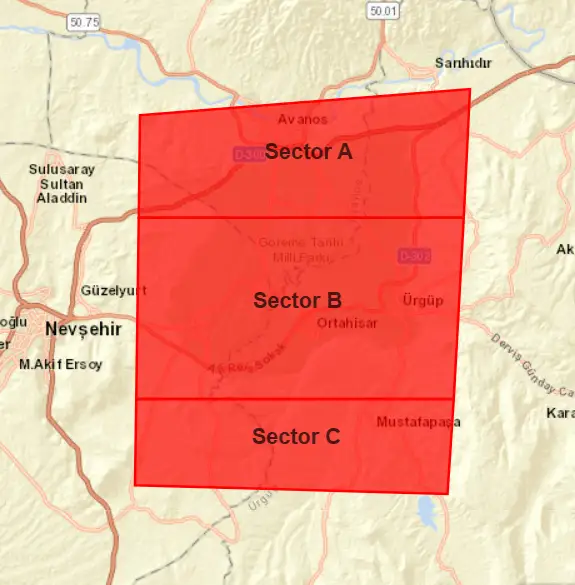
Before any flight window opens, SHGM’s Slot Service Center publishes a mandatory meteorological assessment for the Cappadocia flight zone. A 12-pilot Meteorological Assessment Group (MDG) conducts physical checks across three designated flight sectors — A, B, and C — and issues a colour-coded ruling: red flag means no-fly for all commercial operators, yellow means stand-by but no launch permitted, green means the final go/no-go decision passes to the individual pilot and balloon company. This system, updated before both the morning and afternoon flight periods, is publicly visible at shm.kapadokya.edu.tr. For a live view of today’s flight status across all three sectors, I also publish a real-time tracker at Cappadocia Balloon Flight Status.
On a busy morning, up to 156 balloons operate simultaneously over Cappadocia — out of a total fleet of 367 balloons across 30 licensed companies. Managing that many aircraft in a confined airspace is only possible because of the slot coordination system, which is the first of its kind in the world for balloon operations.
Cancellation decisions are made by the licensed pilot after the pre-dawn weather check — but the notification comes from the balloon company, either directly or through your booking agency.
Month-by-Month Cancellation Rates
These figures are based on field observation across 15 years, cross-referenced with SHGM operational data and seasonal weather patterns for Nevşehir Province. They represent approximate probability that any single morning flight will be cancelled — not that the entire month is closed.
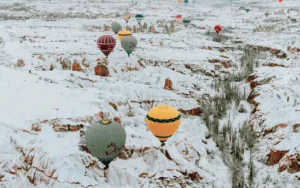
January — 35–45% cancellation rate
The hardest month to guarantee a flight. Cold fronts move through Central Anatolia regularly, bringing both wind and dense ground fog. That said, January mornings with clear skies and calm air produce some of the most dramatic flights of the year — snow-covered valleys, low golden light, near-empty skies (far fewer balloons operate). If you’re flexible and have 3+ nights, January can reward patience.
Best strategy: Book for early in your stay, keep afternoons free for rescheduling.
February — 30–40% cancellation rate
Similar to January but with slightly improving conditions toward month’s end. Fog remains the primary culprit. Valentines’ Day week sees demand spikes — operators sometimes run more balloons than usual, which means more competition for the same sky.
Best strategy: Same as January. Three nights minimum.
March — 20–30% cancellation rate
Transition month. Early March behaves like late winter; late March can feel like May. Wind variability is the main issue — pressure systems can shift overnight. Spring is coming, but it arrives unevenly.
Best strategy: Aim for the last two weeks of March if your travel dates are flexible.
April — 15–20% cancellation rate
Conditions improve noticeably. Easter and school holiday crowds arrive, meaning balloon slots fill faster. The trade-off: if your flight does cancel, rescheduling may be harder due to demand. April mornings — when they fly — are genuinely excellent. Cool, clear, low wind.
Best strategy: Book well in advance. Have a second-morning slot ready.
May — 10–15% cancellation rate
One of the two best months of the year. Stable high-pressure systems dominate. Winds are light, visibility is excellent, temperatures are comfortable on the ground and in the basket. Wildflower season means the valleys below look nothing like summer.
Best strategy: Book any day; one night buffer is usually enough.
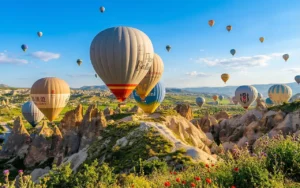
June — 8–12% cancellation rate
Excellent conditions. Long daylight hours, warm mornings, minimal wind. The main issue in June is heat — by 8 AM the ground is warming fast, and thermal activity picks up earlier than in spring. Pilots work within this window comfortably, but it is worth knowing.
Best strategy: Book early in your Cappadocia stay. Rarely needs rescheduling.
July — 10–15% cancellation rate
Counterintuitively, July is slightly less reliable than June. Peak summer heat increases early thermal activity. Some mornings are grounded not by wind or fog but by instability caused by the heat radiating from the volcanic rock. Still excellent overall — just not quite June-level reliable.
Best strategy: Confirm departure time with your operator the night before.
August — 10–15% cancellation rate
Similar to July. The hottest month creates the most thermal instability. That said, August is peak tourist season, and operators are running near-full capacity. If you cancel, rebooking a next-morning slot can be harder.
Best strategy: Book on arrival day or day one — not your last morning.
September — 5–10% cancellation rate
The single most reliable month in Cappadocia. Summer heat dissipates, pressure systems stabilize, and the light at sunrise is exceptional — warm, low-angle, golden. Grape harvest season adds texture to the valley views. September is the month I recommend most often when clients ask for a guarantee.
Best strategy: Any day works. One backup morning is a luxury, not a necessity.
October — 8–12% cancellation rate
Nearly as good as September through mid-month. Late October sees the first autumn fronts move in, which can bring wind. Foliage begins to turn in the valleys — visually one of the best months of the year if you get a clear morning.
Best strategy: Aim for early-to-mid October. Late October starts to resemble November.
November — 20–30% cancellation rate
Conditions deteriorate from mid-month onward. Wind and fog return as winter pressure patterns establish. Early November can still be pleasant — it often has a “second October” quality. But by late November, you’re in winter territory.
Best strategy: Book for the first two weeks. Keep three mornings free.
December — 30–40% cancellation rate
Similar to January. Cold, fog, frequent wind events. December has the additional issue of shorter days — the light at 7 AM in December is dimmer than in any other month, which changes the visual quality of the flight even when it does operate. Worth it for the snow and solitude; not worth it if you need certainty.
Best strategy: Same as January — multiple backup mornings, keep expectations calibrated.
Summary Table
| Month | Approx. Cancellation Rate | Recommended Buffer |
|---|---|---|
| January | 35–45% | 3–4 nights |
| February | 30–40% | 3–4 nights |
| March | 20–30% | 2–3 nights |
| April | 15–20% | 2 nights |
| May | 10–15% | 1–2 nights |
| June | 8–12% | 1 night |
| July | 10–15% | 1–2 nights |
| August | 10–15% | 1–2 nights |
| September | 5–10% | 1 night |
| October | 8–12% | 1–2 nights |
| November | 20–30% | 2–3 nights |
| December | 30–40% | 3–4 nights |
For a full breakdown of Cappadocia’s seasons beyond balloon conditions, see our Best Time to Visit Cappadocia guide.
What Happens If Your Balloon Flight Cancels?
This is the question operators handle badly — and the one that causes the most tourist frustration. Here’s how it actually works:
Notification timing. In most cases, cancellations are announced the afternoon or evening before your scheduled flight — once SHGM’s meteorological assessment for the following morning is published. Your balloon company or booking agency will notify you by WhatsApp or SMS, and your hotel transfer will be adjusted accordingly. Check today’s status
Occasionally, the morning assessment comes back green and transfers proceed — but weather shifts after launch preparations begin. In these cases, you may arrive at the flight field and wait 30 minutes to an hour before SHGM issues a revised ruling and the flight is called off. This is not the norm, but it happens, and it’s worth knowing before you set a 4 AM alarm. The cancellation decision in all cases rests with SHGM, not the individual pilot or operator.
Refund vs. reschedule. Every licensed operator must offer a full refund if they cancel due to weather — this is an SHGM requirement, not operator discretion. Most will also offer a priority rebooking for the next available morning at no extra charge. Accept the rebooking if your schedule allows; same-day rebooking slots are usually confirmed by 8 AM for next-morning flights.
OTA bookings vs. direct bookings. If you booked through Viator or GetYourGuide, your refund goes through their platform — which typically takes 5–10 business days. If you booked directly with a licensed operator (or through an agency like Epic Turkey Travel), the resolution is usually same-day.
What I tell my clients: Don’t book your balloon flight for the morning you’re checking out or flying home. Build in at least one free morning after your scheduled flight. The single most common source of disappointment I see isn’t cancellation itself — it’s cancellation on the wrong day.
Epic Turkey Travel coordinates balloon bookings with trusted SHGM-licensed operators. Yusuf Demir has handled hundreds of weather-cancellation reschedules across 15 years.
Ready to book? Our Cappadocia hot air balloon tour includes hotel transfer and breakfast — and we handle rescheduling directly if weather cancels your flight.
How Many Nights Do You Need?
If you’re visiting Cappadocia and a balloon flight is important to you, here’s the minimum buffer by month:
September–June (peak season): 2 nights gives you a 90%+ chance of flying at least once. One cancel is recoverable. Two consecutive cancels in May–October is rare.
November–March (winter): 3 nights is the minimum I recommend. At a 30–40% daily cancellation rate, two cancels in three days is genuinely possible. If the balloon is non-negotiable, come for 4 nights in winter.
The statistical reality: With a 20% daily cancellation rate and 3 nights, your probability of flying at least once exceeds 95%. With a 40% rate and 3 nights, it drops to around 78%. No one can guarantee weather — but buffer nights are the closest thing to insurance.
Those buffer nights only work if you actually arrive the evening before your first flight window. Transfers from both Kayseri and Nevşehir run 24/7, and a 2 AM arrival costs the same as a midday one — my Kayseri Airport to Göreme guide covers shuttle, private transfer and taxi with current prices.
If you’re planning to combine a morning balloon flight with an afternoon tour, see how to fit both into a single day: Cappadocia Balloon + Day Tour.
FAQ — Cappadocia Hot Air Balloon Cancellation
What is the cancellation rate for Cappadocia hot air balloons?
On average, around 30% of all scheduled balloon flights in Cappadocia are cancelled annually due to weather. This breaks down to roughly 5–10% in September (the best month) and 35–45% in January (the worst month). Operators are required by SHGM to offer full refunds when they cancel.
What month has the fewest balloon cancellations in Cappadocia?
September is the most reliable month, with an approximate cancellation rate of 5–10%. May and June are close behind at 8–15%. If you want the best odds of flying, visit between May and October.
What time do they cancel Cappadocia balloon flights?
Cancellations are typically announced between 4:00 and 5:00 AM, after the pilot's on-site weather assessment. You should receive notification before your pickup time. If you haven't heard by 5:00 AM, contact your operator directly.
Can you get a refund if your Cappadocia balloon is cancelled?
Yes. SHGM regulations require licensed operators to provide a full refund for weather cancellations. If you booked directly with an operator or through an agency, refunds are usually processed same-day. OTA bookings (Viator, GetYourGuide) may take 5–10 business days.
How many days should I stay in Cappadocia to guarantee a balloon flight?
There's no absolute guarantee, but 3 nights gives you excellent odds in most months. In September, 2 nights is usually sufficient. In January or December, I recommend 4 nights if the balloon is a priority.
How many days per year do hot air balloons fly in Cappadocia?
A: Between 220 and 235 days annually, depending on the year. SHGM recorded 223 flight days in 2025 — meaning roughly 142 days were grounded by weather. The most reliable window runs from late April through mid-October. January and December typically see the fewest flyable days.
Yusuf Demir
Professional Tour Guide | Archaeology | History | Art
He has led more than 3,800 tours across Turkey — from the underground cities of Cappadocia to the marble streets of Ephesus. He also spent a year working ground crew and operations at a Cappadocia balloon company — he knows firsthand how SHGM makes pre-dawn flight decisions and what pilots look for before launch. His academic background in Archaeology, Art History, and History of Religions shapes every itinerary he designs. This guide reflects what he actually tells people on the ground, not what looks good on a brochure.